
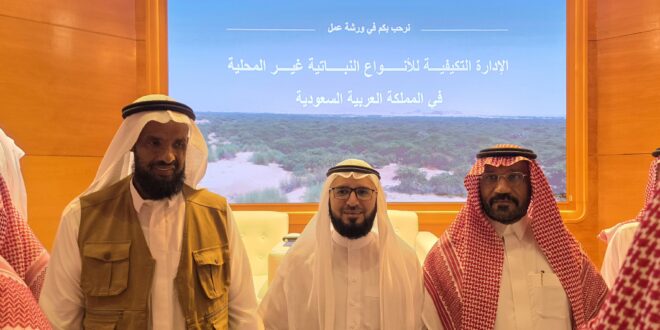
This workshop aims to highlight scientific and practical strategies for addressing invasive plant species
and managing them in a way that ensures the protection of local biodiversity and enhances the sustainability of natural resources, in line with Saudi Vision 2030
Event Details:
- Date: Wednesday, February 25, 2026.
- Location: Jeddah Chamber – Exhibition Center Branch (Al-Nuzha District – Sultan bin Salman Street).
1. Introduction and Workshop Objectives
The National Center for Vegetation Cover Development and Combating Desertification (NCVC) organized a specialized workshop to discuss the status of non-native (invasive) plants in the Kingdom. The workshop aimed to adopt a sustainable approach that achieves a balance between environmental and economic returns, focusing on reducing the negative impacts of these plants on biodiversity, water resources, vegetation cover, and natural pastures.
2. The Concept of Adaptive Management
Adaptive management is defined as an approach aimed at long-term control of sites affected by non-native plants and promoting diversity in local species. This management follows a philosophy of turning challenges (such as the dense proliferation of Prosopis) into investment opportunities, rather than relying solely on a total eradication principle, which international experiments have proven difficult.
Key Pillars of Adaptive Management:
- Scientific Foundation: Includes prevention, containment, selective removal, and ecological restoration.
- Learning from Global Experiences: Leveraging successes and avoiding international pitfalls.
- Adaptive Pathways: Adjusting control scopes rather than random expansion.
- Responsible Economic Utilization: Linking financial returns to limiting plant spread.
- Expected Outcomes: Transforming affected areas into stable sites that support natural regeneration.
3. Stages of Field Implementation
The adaptive management process is conducted through four essential stages:
- Assessment and Identification: Accurately monitoring affected sites based on geographic data.
- Biomass Regulation: Directed engineering interventions to limit spread and enhance the competitiveness of local species.
- Restoration of Ecosystem Functions: Improving light penetration and water movement to allow for natural regeneration.
- Landscape Management: Enhancing spatial connectivity to ensure long-term site stability.
4. The Reality of Invasive Plants in the Kingdom
Field surveys conducted by the Center revealed the following results:
- Monitoring and documenting 45 invasive species belonging to 34 genera and 12 plant families.
- Prosopis trees are among the most prominent, spreading densely in specific areas, particularly in the Jazan region.
- A geographic database has been established to illustrate distribution maps of these species to support decision-making.
5. Economic and Social Returns
Invasive plants can be transformed from a source of threat into an economic resource through:
- Manufacturing Industries: Producing charcoal, bioenergy, timber, and sawdust.
- Supporting Local Communities: Providing job opportunities in the management of these plants and their products, such as honey (subject to regulations).
- Fodder: Prosopis can be used as animal feed provided the seeds are ground to ensure they do not spread through animal waste, and that certification is obtained from the Saudi Food and Drug Authority (SFDA) to ensure it is free from accumulated toxic compounds.
6. Legislation and Community Participation
- Reporting System: The Center launched the “Protect My Environment” platform to receive citizens’ reports on invasive species.
- Permits: The Center grants permits to individuals and government/private entities to remove or manage invasive plants according to scientific protocols.
- Violations: Cultivating any invasive tree is a regulatory violation subject to a fine (1,000 SAR for the first offense, reaching up to 100 SAR for each additional tree by the third offense).
7. Substitution with Local Species (The Arak Experience)
Participants emphasized the importance of “substitution”—planting local species in place of removed invasive plants. The Arak tree (Salvadora persica) was highlighted as a blessed and strategic alternative, due to its ability to withstand salinity, stabilize sand, and its various medicinal and economic benefits (used in over 12 manufacturing industries). The Center has implemented projects to plant Arak, including planting 400,000 seedlings in the Al-Lith region.
8. Final Recommendations
- Continue scientific studies to ensure that invasive plants do not return after removal.
- Strengthen partnerships with the private sector, investors, and environmental associations in management operations and the utilization of pruning by-products.
- Intensify community awareness regarding the risks of invasive plants and proper ways to handle them.
- Adopt successful experiences from other countries (such as Sudan) and apply them locally.This adaptive approach serves as a strategic pathway toward a sustainable environmental future that contributes to achieving the goals of the Saudi Green Initiative.
Recognition and Appreciation
The workshop witnessed a high-level attendance of officials and those interested in the environmental and social sectors. During his attendance, Mr. Abdullah Banjabi, Executive Director of the “Ma’an” Social Development Association, praised the significant efforts made by the National Center for Vegetation Cover Development and Combating Desertification. He emphasized that these scientific initiatives represent a fundamental pillar in protecting the Saudi environment, commending the level of organization and the proposals that serve environmental sustainability in alignment with the goals of the “Saudi Green Initiative.”
In conclusion, the participants extended their deepest thanks and gratitude to the Custodian of the Two Holy Mosques King Salman and his Crown Prince Prince Mohammed, for the unlimited support the environmental sector receives, while also expressing their appreciation to the Jeddah Chamber and all the staff who contributed to the success of this event.