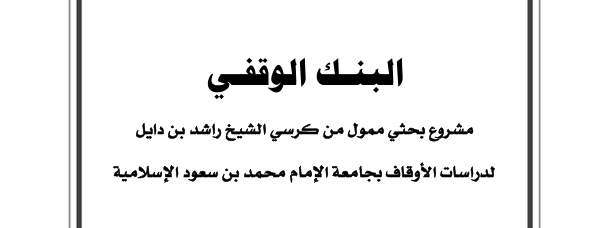
Wadee Binjabi report on the research project of Professor Fahd Abdul Rahman Al-Yahya, Qassim University
1. Executive Conceptual Framework: Merging Tradition with Modern Finance
The strategic evolution of Waqf (Islamic Endowment) from traditional, fragmented management to a sophisticated banking framework is a structural necessity for long-term economic sustainability. Traditional Waqf management has historically been characterized by asset stagnation, illiquidity, and a lack of scalable investment vehicles. By institutionalizing the endowment within a “Waqf Bank” framework, we transition from mere asset preservation to active, professionalized wealth generation. This ensures that endowments are transformed from “locked” dead capital into dynamic engines of growth that provide systemic social empowerment while maintaining their sacred charitable purpose.
Synthesizing the linguistic and technical foundations provided in the source context, the Global Waqf Bank (GWB) is defined through two core pillars:
- Waqf (Endowment): Technically, the “confinement of the asset (Asl) and the devotion of its fruit or yield (Rai’).” It involves the perpetual holding of a property so it cannot be sold or gifted, while its profits are directed toward Al-Birr (charitable causes).
- Bank (Mousasat al-I’timan): Linguistically, the term traces to the Persian Banak (meaning “origin” or “essence”) and the Latin Banca/Bench. This dual heritage reflects the bank’s role as both a “bench” for transaction/exchange and a “chest” (safe) for the protection of assets. Technically, it is a financial intermediary that manages credit and liquidity.
Table 1: Traditional Waqf Management vs. The Waqf Bank Model
| Feature | Traditional Waqf Management | The Waqf Bank Model (GWB) |
| Liquidity Status | Highly illiquid; tied to physical real estate. | High liquidity; manages cash Waqf and deposits. |
| Investment Reach | Localized and direct (e.g., individual rentals). | Global, diversified, and technologically advanced. |
| Institutional Scale | Fragmented; individual Nazir (supervisor). | Centralized Mousasat al-I’timan (credit institution). |
| Operational Goal | Simple preservation and distribution. | Wealth maximization and systemic social stability. |
| Capital Nature | Scattered and prone to inflation erosion. | Pooled “Capital Mass” with professional hedging. |
The “So What?” Layer: The Strategic Paradox The GWB operates as a hybrid entity: a “non-profit organization utilizing profit-generating mechanisms.” This paradox provides a formidable competitive advantage. Unlike commercial banks burdened by shareholder dividend pressure, the GWB reinvests its surplus back into the endowment’s social goals. This enables a lower cost of capital and higher public trust, positioning the GWB as a unique “Social Finance” powerhouse capable of achieving commercial-grade returns to fuel perpetual social impact.
2. Strategic Objectives and Value Proposition
Defining rigorous strategic pillars is essential to protect Waqf assets from the “extinction” caused by mismanagement or economic stagnation. Without a robust banking architecture, individual endowments often suffer from “Diminishing Capital” where inflation outpaces the yield of isolated assets.
The GWB is governed by six primary strategic objectives:
- Institutionalism (Mousasat): Transitioning Waqf from individual supervision to a structured, corporate banking framework.
- Modern Investment Tools: Leveraging sophisticated financial instruments to secure the highest Internal Rate of Return (IRR).
- Pooling Small Endowments: Aggregating scattered charitable contributions to create a unified investment front.
- Sharia-Compliant Alternatives: Providing legitimate alternatives to usury (Riba); specifically, the GWB solves the “intent” problem in organized Tawarruq by removing the profit-maximization incentive inherent in commercial Islamic banks.
- Governance & Transparency: Implementing institutional auditing to ensure Sharia compliance and operational efficiency.
- Financial Efficiency: Protecting the “permanence” of assets through professional risk mitigation.
The “So What?” Layer: The Power of Capital Mass The strategic pooling of small and scattered Waqfs democratizes endowment participation. By aggregating minor contributions, the GWB creates a “Capital Mass” that individual Nuzzar cannot achieve. This allows the bank to bypass high-entry barriers and invest in large-scale infrastructure and sovereign Sukuk, transforming small acts of charity into a centralized, institutionalized economic force that hedges against the inflationary erosion of individual asset value.
3. Benchmarking: Global Precedents and Comparative Analysis
Strategic success requires learning from existing cooperative and social banking models to avoid the drift toward pure commercialism while adopting proven operational efficiencies.
Key global models provide foundational insights:
- European Cooperative Banks: The Raiffeisen and Delitzsch systems demonstrated how non-profit-oriented entities could protect the poor from usury through democratic management.
- Grameen Bank (Bangladesh): A “Bank for the Poor” utilizing group guarantees and micro-credit without traditional collateral.
- Zakat Center (Selangor, Malaysia): An institutionalized corporate structure that reduced poverty through systematic economic development programs.
- Hajj Fund (Jordan): A sophisticated investment-savings model utilizing “Deposit Certificates” (Sukuk al-Ida’) in specific denominations of 10, 50, 100, 500, and 1000 JOD to help citizens save for pilgrimage.
- Waqf Shares (Sudan): A model allowing small donors to ynthesize capital for major projects like gold markets and commercial complexes through “share subscriptions.”
The “So What?” Layer: Permanence (Ta’bid) as a Structural Anchor The GWB differs from European Cooperative Banks in its “Ownership Exit” reality. While cooperative members may eventually exit or sell shares, the Waqf is governed by the principle of permanence (Ta’bid). Once an asset is endowed, it can never return to private ownership. Strategically, this creates a more stable capital base than traditional cooperatives. While the Raiffeisen model often drifts toward commercialism due to member pressure, the GWB’s permanent capital acts as a structural anchor, ensuring the bank remains committed to its social mission in perpetuity.
4. Proposed Operational Models: Selection and Justification
The organizational structure of the GWB must ensure both regulatory compliance with central banks and financial viability. The source identifies three potential formulas:
- The Commercial Bank Formula: A full-service institution accepting deposits, providing financing, and managing a diverse portfolio.
- The Lending-Only Bank (Qard Hassan): A specialized entity focused strictly on interest-free social credit.
- The Investment-Only Bank: An entity functioning as an investment house or private equity firm, focusing strictly on asset growth.
The “So What?” Layer: The Case for the Commercial Model The strategic recommendation favors the Commercial Bank Formula. Beyond the endowment’s own capital, this model acts as a “Liquidity Multiplier” by attracting external deposits. There is a massive ethical opportunity here: in Saudi Arabia alone, approximately 150 billion Saudi Riyals are held in current accounts that do not earn interest. The GWB can capture these funds for social good. Furthermore, as a “General Waqf,” the bank qualifies for approximately 35% tax and Zakat exemptions in various jurisdictions, a benefit that significantly boosts the IRR compared to standard commercial investment houses.
5. Sharia Foundations and Investment Mechanisms
Sharia-compliant grounding is the “Absolute Ground Truth” for the GWB’s legitimacy and the foundation of public trust. The bank’s operations are supported by several legal justifications:
- Investment of Cash Waqf (Waqf al-Nuqud): The permissibility of endowing liquid cash provides the necessary “Seed Capital” for banking operations.
- Yield (Rai’) vs. Original Asset (Asl): The mandate to preserve the Asl while utilizing the Rai’ for social credit and reinvestment.
- Mechanisms for Qard Hassan: Using a percentage of yields to provide interest-free loans to the underprivileged.
The “So What?” Layer: Investment Criteria as Risk Management The Islamic Fiqh Academy mandates 15+ criteria for Waqf investment, including:
- Prioritizing local and regional development projects.
- Rigorous documentation of all contracts and transactions.
- Diversifying portfolios across sectors to reduce risk.
- Selecting the most profitable permissible alternative.
Strategically, these are not merely religious obligations; they constitute a Sophisticated Risk Management Framework. By demanding high levels of documentation and avoiding speculative high-leverage traps, these Sharia constraints protect the bank from the “bubbles” and systemic failures common in traditional commercial banking.
6. Governance, Risk Management, and Financial Oversight
Governance is the shield that prevents the “extinction” of Waqf assets. To operate at global standards, the GWB must adhere to the oversight of the Monetary Agency (SAMA equivalent) and the Bureau of Accountancy (Diwan al-Muhasabah).
Key requirements include:
- Independent Sharia Supervision Boards: To audit product compliance.
- Capital Adequacy & Liquidity Coverage Ratios: Tailored to the unique constraints of permanent capital.
- Emergency Reserves: A strategic portion of the Rai’ (yield) must be diverted to an “Emergency Reserve” to meet obligations during economic downturns without touching the Asl.
The “So What?” Layer: Conservative Liquidity Management In a Waqf context, liquidity management must be more conservative than in traditional commercial banks. Because the Asl is sacred and non-withdrawable, the GWB cannot tolerate the same liquidity risks. Strategically, this creates a bank with a “Permanent Capital” base—an entity that is inherently more resilient to bank runs and liquidity crises than institutions reliant on volatile, short-term private deposits.
7. Strategic Implementation Roadmap and Conclusion
The transition from research to a functioning global entity requires a phased approach:
- Phase 1: Theoretical & Legal Grounding: Finalizing Sharia and economic feasibility studies.
- Phase 2: Regulatory Licensing: Securing commercial permits from Central Banks and the Ministry of Awqaf.
- Phase 3: Asset Pooling & Subscription (Iktitab): Launching share subscriptions to attract initial “Cash Waqf” and seed capital.
- Phase 4: Pilot Operations: Launching specific micro-lending and investment programs.
The “So What?” Layer: The Socio-Economic Horizon The Global Waqf Bank represents a shift toward Systemic Financial Stability. By pooling small endowments and institutionalizing Qard Hassan, the GWB creates a self-sustaining ecosystem that replaces “one-time” charity with “perpetual” economic empowerment. In an era of global financial volatility, a bank built on permanent, non-withdrawable capital acts as a vital hedge against systemic crises.
The Global Waqf Bank is the future of Islamic social finance—an institution that honors the tradition of the endowment while wielding the tools of modern finance to build a resilient, equitable, and sustainable global economy. Through professional management and Sharia-compliant innovation, the Waqf becomes the pillar of a new financial era.